Updated:
What Is the Test Development Process?
Test development involves a series of steps to create an exam, from defining what it should measure to developing and assembling test items. But the work continues even after an exam is developed.
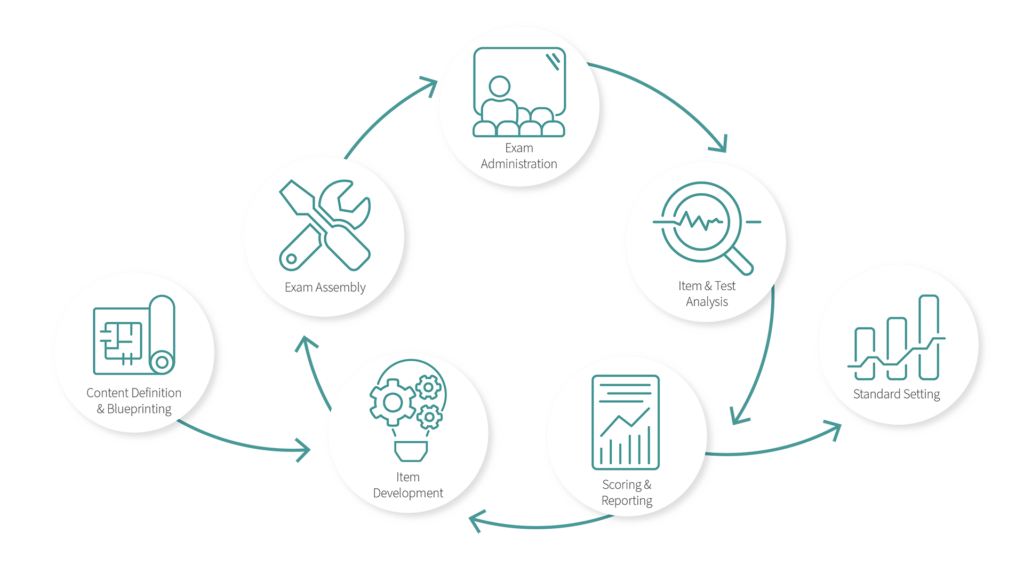
The Assessment Life Cycle, an illustration coined by Meazure Learning psychometricians, helps simplify and visualize seven stages of the testing process: content definition and test blueprinting, item development, exam assembly, test administration, item and test analysis, scoring and reporting, and standard setting. This process is cyclical, not linear. Through this seven-stage method, we demystify the testing process so you can be confident in your exam results, whether you’re a seasoned psychometrician or new to the testing world.
Stage 1: Content Definition and Test Blueprinting
Content definition and test blueprinting establish what an exam should measure and how that content should be represented on the exam. During this stage, we get to know your testing program and your goals. This lays the foundation for the test blueprint and all the following stages of the Assessment Life Cycle. This first and vital step in test development ensures your exam is valid, fair, and defensible.
Our specialized services include:
- Competency profiling and job task analysis
- Surveys and consultation
- Developing test specifications/blueprints
For more, download a white paper that goes into detail about Stage 1 of the Assessment Life Cycle.

Stage 2: Item Development
Item development involves creating, reviewing, and refining exam questions so they accurately measure the knowledge, skills, or abilities defined in the test blueprint. Our team of psychometricians will coach you through the item writing, analysis, editing, and review process so you can fill your item bank with questions that have been vetted and tested before being used in your exam.
Our specialized services include:
- Item analysis review for existing exams
- Item writing workshops and guides
- Professional item development
- Item development project management
- Item translation services

Stage 3: Exam Assembly
During exam assembly, test items are selected and organized into an exam form that meets the specifications established in the test blueprint. In other words, the puzzle pieces have been created, so now it’s time to put them together. Our team will help you create exam forms that meet your program’s needs. Looking for an automated solution? We can do that, too, with the Meazure Exam Platform.
Our specialized services include:
- Automated test assembly (ATA)
- Facilitation of the examination validation process
- Practice test development

Stage 4: Test Administration
Test administration involves delivering an exam to test-takers under secure and consistent conditions while protecting highly sensitive information. Our exam administration team handles everything from test-taker, test center, and proctor management to online administration with online proctoring and more. Flexibility and customization to meet your program needs are key in this stage.
Our specialized services include:
- Paper-to-computer transition
- Collusion detection
- Test center network
- Remote proctoring services
- Meeting accreditation standards

Stage 5: Item and Test Analysis
Item and test analysis uses test-taker response data to evaluate how individual items and the overall exam perform. Our team of psychometricians will review the results of your exam to ensure that both the overall exam and each item work as they should. Based on our findings, we will consult with you to determine whether to keep, revise, or remove questions for future tests.
Our specialized services include:
- Classical Test Theory (CTT) item analysis
- Item Response Theory (IRT) item analysis
- Differential Item Functioning (DIF) analysis

Stage 6: Scoring and Reporting
Scoring and reporting turn test-taker performance into exam results and communicate those results in a way that supports their intended interpretation and use. Scoring can be automated through our software, but our psychometricians will work with you to develop a scoring plan to ensure accuracy and efficiency for high-stakes exams. The reporting of these results is highly customized for each partner to provide detailed information.
Our specialized services include:
- Redundant scoring using different forms of software to ensure accurate calculations
- Statistical equating between examination forms
- Customized test-taker, school, and national results reporting

Stage 7: Standard Setting
Standard setting establishes the level of performance a test-taker must demonstrate to pass an exam. This is a critical decision that can affect the lives of the people your test-taker is going to serve. We work with you to set a cut score that is informed by the knowledge and skills that your examination is meant to assess.
Our specialized services include:
- Consultation and training on various standard-setting methods (e.g., Angoff, Ebel, Bookmark, Borderline)
- Facilitation of standard-setting sessions with subject matter experts
